
Quick Answer
WordRocket and NeuronWriter solve different problems, not the same one. Pick WordRocket if you need full SEO articles written fast. Pick NeuronWriter if you have writers and need SERP-driven optimization. Most serious operators use both [1], [2].
Key Takeaways
- WordRocket and NeuronWriter solve different problems and are best used together
- WordRocket is the fastest path from keyword to publishable WordPress draft
- NeuronWriter is the most reliable way to make a draft actually rank
- Combined monthly cost on entry plans is about $33 ($10 WordRocket Starter + $23 NeuronWriter Bronze)
- WordRocket lifetime deals ($199 to $399 once) are the cheapest long-term path on this stack
- Neither tool eliminates the need for human editing on facts and tone
Contents13 sections
- Who This Comparison Is For
- The 30-Second Verdict
- What WordRocket Actually Is (and What It Does Well)
- What NeuronWriter Actually Is (and What It Does Well)
- Pricing Compared (Honest Numbers)
- Feature-by-Feature: Where Each Tool Wins
- What Each Tool Actually Outputs
- When You Should Pick WordRocket
- When You Should Pick NeuronWriter
- The Honest Answer: Use Both
- Common Mistakes Buyers Make
- The Bottom Line
- Frequently Asked Questions
Who This Comparison Is For
This comparison helps three types of content creators decide which tool fits their workflow. Each one needs a different answer. Solo bloggers, agency teams, and ecom marketers all run different content creation patterns, so find yourself below before you read the rest.
The solo founder. You publish blog content yourself. You have no writing team. You need articles done in under 30 minutes. Your time matters more than your budget.
The content manager. You run a team of writers or agencies. Your bottleneck is not drafting. Your bottleneck is making content actually rank on Google.
The ecom store owner. You sell products and need a steady blog. You write for SEO traffic, not thought leadership. You care about ROI per article.
The 30-Second Verdict
Here is the comparison at a glance. The full breakdown is below.
| Factor | WordRocket | NeuronWriter |
|---|---|---|
| Primary job | Generate full articles | Optimize content for SERP |
| Best for | Solo founders, agencies, ecom blogs | SEOs, content teams, optimizers |
| Output | Finished WordPress-ready post | Content score and term list |
| Speed | 5 to 10 minutes per article | Minutes for SERP analysis |
| Pricing starts at | $0 free, $10/mo Starter, $199 once for Pro LTD | $23/mo Bronze (no free plan) |
| Lifetime deal | Yes, always on their site ($199-$399 once) | Yes, periodically on AppSumo |
| Learning curve | Low. Type keyword, get article | Medium. SEO knowledge helps |
What WordRocket Actually Is (and What It Does Well)
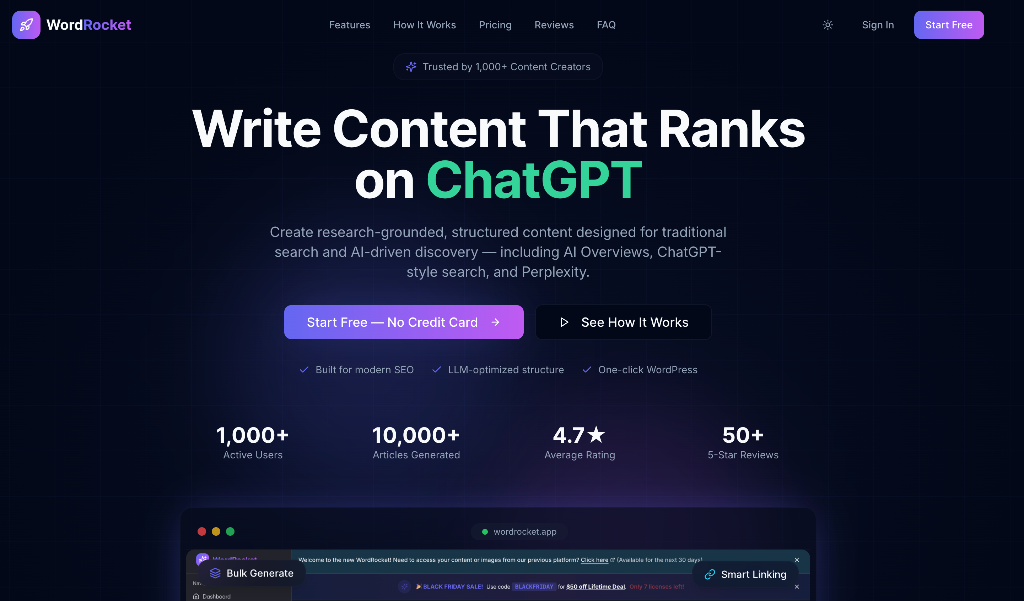
WordRocket is an AI article generator built for the modern search era. You give it a keyword and a brand voice. You get back a full, formatted, WordPress-ready post in under 10 minutes [3]. That post has headings, body copy, FAQs, generated tags, AI images, and internal-linking suggestions from your sitemap. WordRocket explicitly markets itself for AI search engines, ChatGPT, Perplexity, and Google AI Overviews, not just classic Google.
Where WordRocket wins is the publish loop. It does not stop at giving you text. It connects directly to your WordPress or Ghost site. You can publish drafts from the WordRocket dashboard. That removes the most tedious step of AI content workflow.
Where WordRocket shines:
- Speed. A 2000 word article finishes in under 10 minutes
- Bulk generation. Queue 20 keywords and walk away
- Brand voices. Save tone profiles per client or project
- Image generation. Hero and inline images included
- Direct WordPress publishing. No copy-paste needed
Where WordRocket falls short:
- Output still needs human editing for tone and facts
- No SERP analysis or content scoring built in
- NLP term recommendations are weaker than dedicated SEO tools
- Long content (3000+ words) sometimes feels padded
What WordRocket actually sells is an ai-powered content generator with a publishing loop. Pre-built templates speed up the start: listicles, how-to guides, product reviews, ultimate guides, and roundups. You type a prompt for your keyword and pick a template. The generated content lands in your WordPress site in one click. For most users, the writing assistant feature is secondary to that workflow speed.
You do not buy WordRocket because the AI is smarter than ChatGPT. You buy it because the workflow is faster than ChatGPT plus copy-paste plus image search plus formatting plus uploading.
What NeuronWriter Actually Is (and What It Does Well)
NeuronWriter is a SERP analysis and content optimization platform [4]. It scrapes the top 10 ranking pages for your target keyword. It extracts the terms, headings, questions, and entities they share. Then it scores your draft against that benchmark.
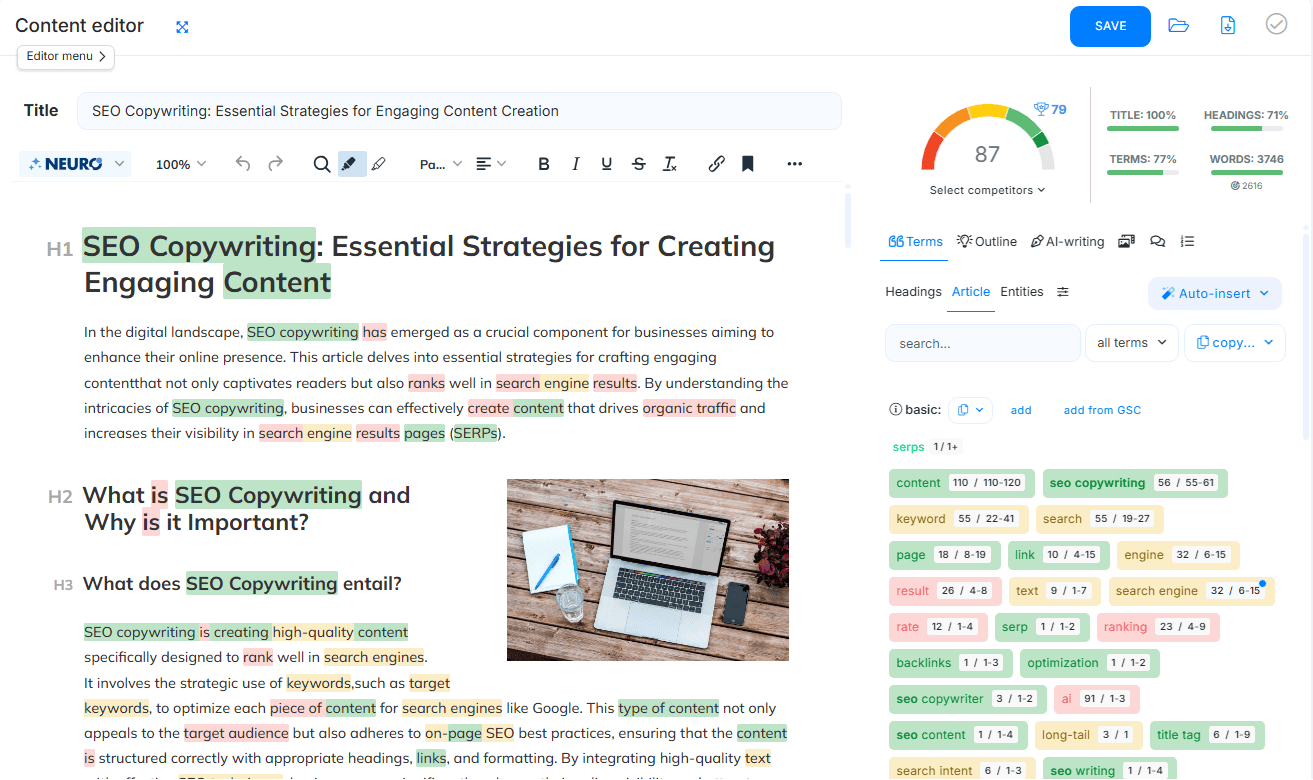
The content score is the core feature. You write or paste your article into the NeuronWriter editor. It tells you which terms you are missing. It shows you how your draft compares to the top 10 pages. That feedback loop closes a gap most writers cannot see on their own.
Where NeuronWriter shines:
- SERP-driven term lists. You see exactly what the ranking pages cover
- Content score. A number you can target and improve
- Competitor outlines. Reuse proven H2 and H3 structures
- People Also Ask questions. Built-in FAQ source material
- WordPress plugin. Score your existing posts in place
- Lifetime deal. Available on AppSumo at a fraction of monthly cost
Where NeuronWriter falls short:
- The built-in AI writer is fine but not class-leading
- Learning curve is real if you have never used SEO tools
- UI feels dense at first compared to clean writing tools
- You still need a writer or another AI to actually draft
NeuronWriter functions as a real-time optimization layer, not a content generator. The real-time content score updates the moment you paste a draft, which makes SEO optimization gaps visible immediately. It pulls People Also Ask questions and connects to Google Search Console when you link a project, so content planning is grounded in your own search data. For content creators managing multiple domains, this is one of the strongest content tools in the SERP-driven optimization category.
NeuronWriter is not a writer. It is a coach. You can use any AI or human to draft. NeuronWriter tells you whether the draft will rank. Frase does something similar at higher cost. Surfer SEO competes on the same shelf.
Pricing Compared (Honest Numbers)
Pricing is where most comparisons get fuzzy. Here are the real numbers from each vendor at the time of writing.
| Plan | WordRocket | NeuronWriter |
|---|---|---|
| Free tier | Yes, $0 forever, 10 articles per month, BYOK | No free tier (trial only) |
| Entry paid | Starter, $10/mo (unlimited articles, 1 site) | Bronze, $23/mo (2 projects, 25 analyses) |
| Mid tier | Pro, $20/mo (5 sites, bulk generation) | Silver, $45/mo (5 projects, 50 analyses) [5] |
| Power tier | Premium, $49.99/mo (10 sites, priority support) | Gold, $69/mo (10 projects, 75 analyses) |
| Lifetime path | Pro LTD $199 once, Premium LTD $249 once, Agency $399.99 once | Lifetime via AppSumo (periodic) |
| AI model costs | BYOK, pay Claude / Gemini / Perplexity directly | Included in plan |
The headline difference is the pricing model. WordRocket sells both monthly subscriptions and lifetime deals from one menu. NeuronWriter is monthly-only on their site, with periodic AppSumo lifetime drops. Both tools use BYOK or include AI model costs differently, which matters at scale.
On the monthly side, the entry tiers are close, WordRocket Starter at $10 versus NeuronWriter Bronze at $23. WordRocket adds API costs through BYOK, which typically lands at $10 to $30 per month depending on volume and model choice. NeuronWriter includes everything in the plan. For high-volume publishers, WordRocket Pro Lifetime at $199 one-time pays back in roughly 10 months versus paying $20 per month forever. NeuronWriter does not advertise a permanent lifetime path on its site, though AppSumo deals appear occasionally [5].
Feature-by-Feature: Where Each Tool Wins
This table covers the features most buyers actually compare.
| Feature | WordRocket | NeuronWriter |
|---|---|---|
| Full article generation | Yes, native | Limited, secondary feature |
| SERP content analysis | No | Yes, core feature |
| NLP term recommendations | Basic | Strong |
| Content score | No | Yes |
| Direct WordPress publish | Yes | Via plugin |
| AI image generation | Yes, included | No |
| Brand voice profiles | Yes | No |
| Bulk article generation | Yes | No |
| Competitor outline scraping | No | Yes |
| FAQ schema generation | Yes | Manual |
| Team seats | From mid tier | From Silver tier |
If you read that table top to bottom, you see the tools barely overlap. WordRocket fills the generation column. NeuronWriter fills the optimization column. They are complementary, not competitive.
What Each Tool Actually Outputs
This is where the two tools look most different in practice. They produce different artifacts at the end of a session.
WordRocket’s deliverable: a finished, formatted article ready for WordPress. Headings, body paragraphs, FAQ section, hero image, internal-linking suggestions from your sitemap, and a publish button. You go from a keyword to a draft your editor can polish in a single session. The output is built specifically for AI search engines like ChatGPT, Perplexity, and Google AI Overviews, which is where buyer traffic is shifting fastest.
NeuronWriter’s deliverable: a SERP intelligence report and a live content score. You get a ranked list of NLP terms from the top 10 pages, competitor H2 structures, People Also Ask questions, and a numerical content score that updates as you write or paste a draft. There is no full article generated unless you use the secondary AI writer. The output is strategy and feedback, not finished prose [6].
The honest read: WordRocket produces a publishable rough draft in minutes. NeuronWriter produces a publishable strategy in seconds. Combining them produces an article that actually has a real chance to rank, with each tool covering what the other lacks.
When You Should Pick WordRocket
Pick WordRocket if any of these apply to you:
- You are a solo founder publishing 5+ articles a month with no writing team
- You run an agency churning out client content at scale
- You have a programmatic SEO play with hundreds of similar pages
- You want one tool that handles drafting plus images plus WordPress publishing
- You prefer pay-once over recurring subscriptions and are comfortable with BYOK (your own Claude or Gemini API key)
- You publish content built for AI search engines like ChatGPT, Perplexity, and Google AI Overviews, which WordRocket explicitly optimizes for
- You value speed over the perfect content score
WordRocket is a workflow tool first. The AI inside is secondary. If your pain is hours-per-article, this is the answer.
When You Should Pick NeuronWriter
Pick NeuronWriter if any of these apply to you:
- You have writers (human or AI) already producing content
- Your articles are not ranking and you do not know why
- You want to revamp existing posts for better SERP performance
- You run a niche site where each post needs to actually compete in Google
- You prefer one-time payment via the lifetime deal over monthly subscription
NeuronWriter is an optimization layer. If your pain is articles-not-ranking, this is the answer.
The Honest Answer: Use Both
The serious answer for most operators is to run both. Here is the workflow we use on this site.
- NeuronWriter first. Submit the keyword. Get the SERP analysis, term list, and competitor outlines
- WordRocket second. Give it the keyword plus the NeuronWriter term list pasted in as guidance
- NeuronWriter third. Paste the WordRocket draft into the NeuronWriter editor and check the content score
- Inject missing terms. NeuronWriter shows exactly which terms the draft is missing. Add them naturally
- Publish via WordRocket. Push the final version straight to WordPress
This combined content strategy works especially well for long-form, SEO-optimized pieces where ranking matters most. Each tool does what it does best: WordRocket creates content fast and NeuronWriter ensures the seo content earns its place in the top 10. For professional content teams, this two-step process replaces hours of manual research with minutes of structured intel.
The combined cost depends on your model. WordRocket Pro at $20/mo plus NeuronWriter Bronze at $23/mo runs $43 per month, plus your own API spend on Claude or Gemini. If you grab WordRocket Pro Lifetime at $199 one-time and pair it with NeuronWriter Bronze, year one runs about $475 all in. After year one, ongoing cost is just $23/mo for NeuronWriter plus API. Cheaper than one freelance writer for a single article in either scenario.
Common Mistakes Buyers Make
Three mistakes we see often. Avoid each one.
Mistake 1: Buying NeuronWriter expecting an AI writer. The built-in AI is fine but not the reason to buy. You buy NeuronWriter for the content score, not the writer. If you want a writer, look at WordRocket, Jasper, or Claude.
Mistake 2: Buying WordRocket expecting articles that rank. The output is a strong rough draft. The output is not search-engine-optimized to the level a SERP analysis tool would produce. Treat WordRocket as a 70 percent finished article, not 100 percent.
Mistake 3: Underestimating WordRocket BYOK costs. WordRocket subscriptions and lifetime deals do not include AI model usage. You pay Claude, Gemini, or Perplexity directly through your own API key. Most users land at $10 to $30 per month in model costs at typical publishing volumes. Budget for it before buying the lifetime deal expecting zero ongoing spend.
The Bottom Line
Want a wider view before you commit? See our roundup of the best AI SEO tools for 2026 to compare these two against other options.
WordRocket and NeuronWriter are not competitors. They are layers in the same stack.
WordRocket is the writer. NeuronWriter is the editor. If you only have budget for one, pick the one that solves your bigger bottleneck. If your articles never get drafted, that is WordRocket. If your articles never rank, that is NeuronWriter.
If you are serious about a content site that earns money, use both. The combined monthly cost is less than one freelance writer. The output beats either tool alone by a wide margin.
Next steps if you are ready to move:
- Try NeuronWriter on the entry plan to see if SERP analysis fits your workflow
- Try WordRocket on the entry plan to see if AI drafting matches your voice
- Decide which solves your bigger problem first
- Layer the second tool in once the first is paying off
References
- What are Your Favorite Writing Tools? (AI, Optimization, Etc.) | Builder Society (www.buildersociety.com)
- g2.com (www.g2.com)
- 7 Best NeuronWriter Alternatives in 2026 (Tested & Compared) (republishai.com)
- Neuronwriter vs Wordhero: Which One Surprised Me? (www.linkedin.com)
- Which AI models does NEURONwriter use for content generation? – NEURONwriter – Content optimization with #semanticSEO (neuronwriter.com)
- WordRocket Features, AI search-optimized content generation (wordrocket.ai)
Frequently Asked Questions
Is NeuronWriter worth the money in 2026?
Yes, if you publish content and need it to rank. The content score plus SERP analysis is the core value. If you do not care about SEO, skip it.
Can WordRocket write articles that actually rank on Google?
WordRocket produces drafts that can rank with editing. They will not rank as-is in competitive niches. Layer in SERP analysis from NeuronWriter or similar.
Does NeuronWriter have an AI writer built in?
Yes, but it is a secondary feature. The core product is SERP analysis and content scoring. The AI writer works for short sections, not full articles.
Can I publish directly to WordPress from either tool?
WordRocket yes, native. NeuronWriter via a free WordPress plugin that scores your posts in place.
Which one has a lifetime deal?
NeuronWriter regularly appears on AppSumo with a lifetime deal. WordRocket has had brief AppSumo runs but is mostly subscription. Check current AppSumo listings.
How does NeuronWriter compare to Frase or Surfer SEO?
All three are SERP-driven content optimizers. NeuronWriter wins on price especially with the lifetime deal. Surfer wins on UX polish. Frase wins on AI integration. Output quality is similar across the three.
Can WordRocket handle bulk article generation?
Yes. You can queue dozens of keywords at once. This is one of WordRocket’s strongest features for agencies and programmatic SEO.
Does WordRocket generate AI images?
Yes. Hero and inline images are included with every article. Quality is decent for blog purposes. For premium product shots use kie.ai or Midjourney instead.
Which one integrates with Google Docs?
NeuronWriter has a Google Docs add-on. WordRocket exports HTML or pushes directly to WordPress. Neither has a deep Google Docs editor.
What is the learning curve for each?
WordRocket is faster to learn. Type a keyword and you have an article. NeuronWriter takes a few hours to learn well. Understanding the content score and term recommendations requires basic SEO context.
Can I use NeuronWriter to revamp old WordPress posts?
Yes, this is one of its strongest use cases. The WordPress plugin scores existing posts and shows you which terms to add. Most sites have 20 to 50 posts that could double their traffic with a revamp.
What is the best workflow for combining both tools?
Run NeuronWriter first for SERP analysis. Use the term list to brief WordRocket. Score the WordRocket draft in NeuronWriter. Inject missing terms. Publish. This combined workflow is what we use on this site.
Last Updated: 2026-05-17